The Scam Economy
Time for a New Coalition

Much has been in the news of late regarding fake daycares, fake autism therapy centers, and fake hospices. The scale of the fraud is almost unbelievable, on the order of tens of billions. Since none of these businesses produces legitimate goods in a voluntary transaction with a customer, the money they collect serves to bid up the cost of goods and services for everyone, while contributing nothing to total economic output.
The idea of building actual things people value, like a Ford or Toyota, seems almost quaint, and it’s hard to say if those who do so are heroic or pitiable. Serving actual customers and making a profit is freaking hard, and there’s certainly the temptation, in a general decline, to, if I can’t beat them, join them, and get what’s mine.
Hard vs. Soft Scams
Recent news focused on hard scams, actual fraud, not the much broader areas of vice and cheating. A few examples will serve to illustrate.
A few years ago, we had some significant investments in the “tobacco” space. We were encouraged by the coming transition to reduced-harm or zero-harm nicotine products and had a thesis that nicotine, as the ultimate nootropic and thus marijuana’s virtuous opposite chemical in its effects, would make a comeback as the stimulant of choice for high achievers, eventually seen as safe and harmless as caffeine (which is consistent with the data in Sweden, where reduced-harm products have zero net effect on mortality relative to non-users). It’s no exaggeration to say that caffeine and nicotine may have catalyzed Western man’s latent Promethean drive from the Reformation to the Scientific Revolution to the moon landing in just a few centuries.
We assumed, given the uneasy but durable alliance between states dependent on tax revenue and regulatory capture of the industry, that reduced-harm products would be owned by the industry incumbents and responsibly regulated to wall off these products from minors. The FDA did this, notably, when they forced pouch and vape manufacturers to file applications demonstrating the safety of their formulations, while, in the case of vapes, requiring manufacturers like Juul and NJOY to add bitterants to their products to make them taste like cigarettes, not candy, to make them less appealing to kids and ideally only appealing to smokers seeking a healthier alternative. The regulated American manufacturers complied, and thus, kids would be protected, and our investments would enjoy a nice little oligopoly with pricing power.
We ended up exiting those investments for a smaller profit than expected a couple of years ago, when the thesis proved false, in that the heretofore effective regulatory regime of nicotine products failed against the swarm of Chinese-manufactured vapes and Indian-owned convenience stores and smoke shops. These immigrants do not quietly comply with laws, but rather demand a level of enforcement resources our country lacks. Here’s a typical display from a recent road trip:
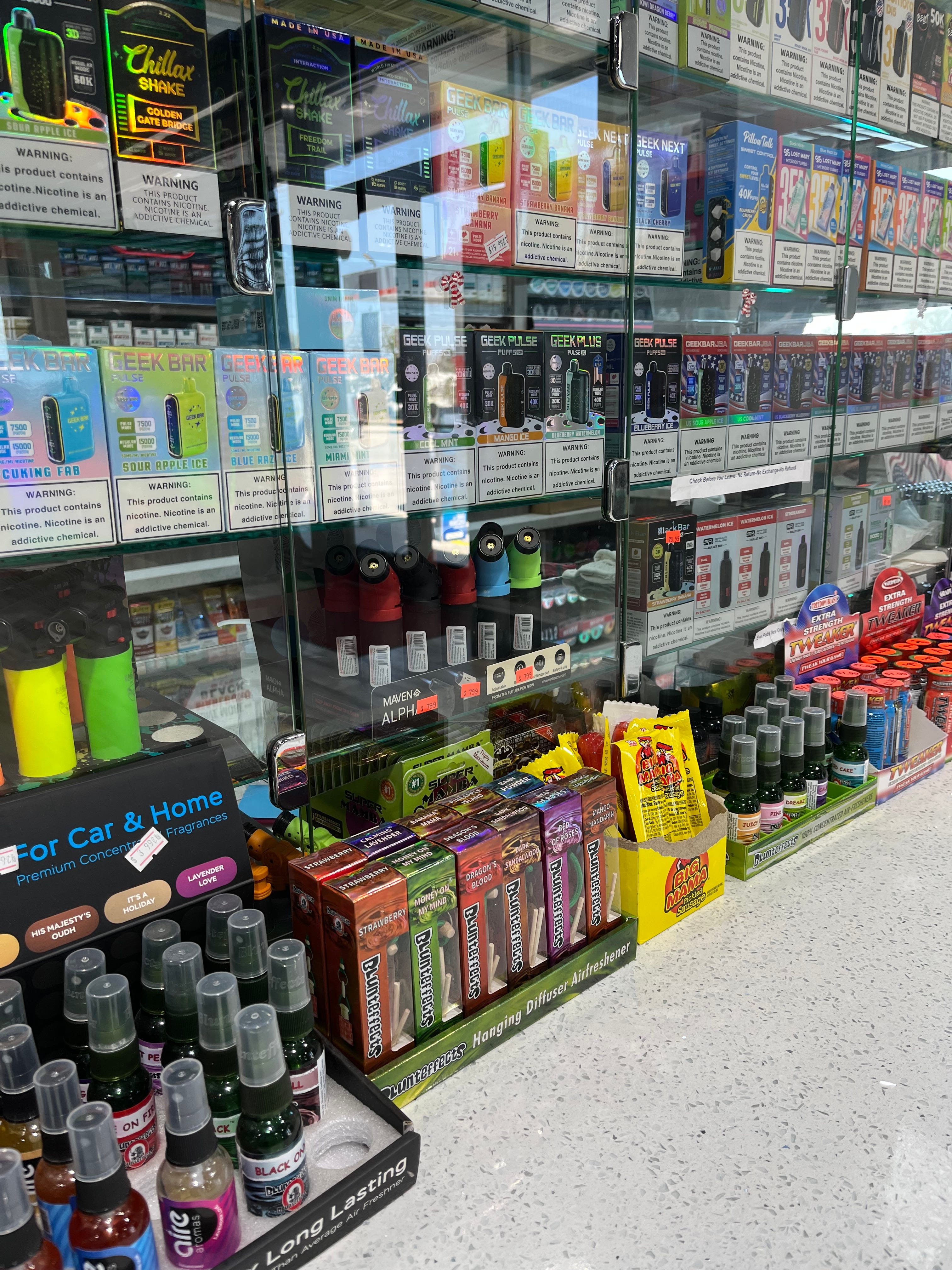
Above this display, but unpictured, were several offerings of THC-related compounds that are similar in psychoactive effects but chemically modified to evade state law, laws our Republican legislature was too cowardly to fix, given the power of the pot lobby. Why do we never hear of convenience store and vape shop owners being perp-walked for selling these illegal products? Why do taxpayers subsidize the proliferation of these trashy little stores with SBA loans for non-citizens1? And how are responsibly manufactured, safe, properly regulated American products supposed to compete when the Chinese flood our country with illegal ones?
Big Time Soft Fraud
But this is small-time as the hollowing of norms and voluntary compliance reaches its full apogee in international trade. The most valuable intellectual property in the world is arguably Eli Lilly’s patent on tirzepatide, the most effective weight loss drug. Yet, despite the FDA’s closing of loopholes, a simple Google search will reveal dozens of sources for compounded, pirated tirzepatide sourced from Chinese labs.
Given that the stuff is sold as a powder and doses are measured in milligrams, it would seem almost impossible to cut this off from international trade, at least on the black market. Nevertheless, scammers operate openly and domestically to undercut Lilly’s intellectual property investment, and nothing happens. In cities like Houston, it’s trivial to receive a prescription from an immigrant doctor and fill it from an immigrant-run pharmacy, since Americans playing by the rules largely no longer operate the compounding pharmacy industry, which used to be a niche service for patients needing strange or alternative dosing of common medicines not otherwise commercially available.
Now here’s the weird part. Drug manufacturers in China can “register” with the FDA, pass one inspection, and sell any drug into compound pharmacies. And in this case, one part of the government doesn’t talk to the other. Such firms can rip off US intellectual property, and this does nothing to affect their FDA approval. Many of these inspections, due to FDA backlogs, are only subject to “remote inspections,” i.e., the FDA looks at paperwork submitted electronically, trusting Chinese firms to self-report their compliance! And, as long as they register with the FDA and apply for inspection, they can begin selling into the US market before they’re ever inspected. And if they get inspected and fail, they can close up shop, register again under a new entity, and be good for another few years. Trump was right, they really must be “laughing at us” for being such easy, dumb marks.
Regulations surrounding such pharmacies, like those of the IRS, depend on Anglo-Saxon norms of voluntary self-regulation, not police inspection. They simply no longer work when those norms are not shared by many of our residents and trade partners.
Many Americans are likewise unaware that most of their generic medications are made in India or China. These manufacturers, who are outside of US criminal jurisdiction attaching to impure drugs, are allowed by our government to have FDA approval. My first job, some readers may recall, was at an FDA-regulated facility. It was drilled into all of us to never slack on quality or record-keeping because of the dreaded “surprise inspection.” The FDA can show up at any time and start digging, and while rare, veterans at the company had war stories of previous inspections. The company itself maintained its own internal “red team” of surprise inspectors, many former FDA, who often showed up at manufacturing plants unannounced to simulate government inspections. QA and manufacturing people could and would be fired if internal inspectors found serious problems likely to surface in an official one. We also knew about the criminal penalties for major negligence discovered in such an inspection. Almost no one actually went to jail for this, of course, but the thought of being arrested and having a “criminal record” scared our domestic employees terribly. It was understood to be a high privilege to make products people trusted to put into their bodies.
That system is imperfect enough in the US as Christian norms recede2, but imagine we had a competitor in China or India. Technically, they are FDA-approved and subject to surprise inspections. But the manpower to do so, and the criminal penalties, are absent. And in any of these countries, the odds that the FDA can actually execute a surprise inspection are extremely low, simply because their movements can be easily tracked or shared with the manufacturer by locals. And absent criminal penalties enforced by US courts, records can be falsified, and lies told without consequence. How could a US manufacturer possibly compete with such regulatory asymmetry? The expense in making a medicine is all in quality control and compliance, not raw materials. And the price we pay is impure drugs and the hollowing out of our ability to make the world’s most useful medicines domestically (the most valuable medicines, i.e., the low-hanging fruit, tend to be older proven generics).
At a similar scale but with a more dispersed impact has been Amazon’s effect on small American manufacturers, famously chronicled by Austin-based entrepreneur Molson Hart’s futile attempts to have the online platform play fair and respect his intellectual property. On a recent episode of Shark Tank, Kevin O’Leary pronounced the futility of preventing knock-offs on Amazon, even with a patent, and recommended that brands knock themselves off with white labels selling just above cost to at least gain some small return on sales that would otherwise go to Amazon scammers3.
Again, the incentives of our laws make it almost impossible to compete on a legitimate basis. Section 230, an early Internet law designed to indemnify online forum operators from liability for their users’ speech, has been interpreted to protect Amazon from the acts of its resellers. By contrast, Target, with a conventional vendor reselling relationship, is often jointly and severally liable with the source of goods for any tort. Honest retailers can be sued, but if you turn your website into a bazaar for foreign scammers to lie, cheat, and steal on your behalf, it’s “user-generated content” and statutorily excluded from any liability, even if, like Amazon, the platform controls the entire customer relationship from billing to fulfillment to communications to returns.
At the other end of the value chain, the fundamental currency of American meritocracy itself, the SAT, finds itself dealing with Chinese websites that publish the contents of every test online within hours of administration. The dumb WASPs who run the SAT were gullible enough to allow Chinese students to use their own devices, in China (well, Hong Kong and Macau, same culture), to take the tests. And thanks to Obama abandoning US sovereignty over ICANN domain name registrations, there’s nothing SAT can do about it.
And that’s East Asia, maybe the most functional non-Western culture. Things get much darker elsewhere. Nigerians and other third-world financial scammers torment our vulnerable elderly, often with the help of domestic mules. Why are they allowed on Facebook, and why is Facebook immune from liability for allowing this on their platform4? Has anyone asked the question of why Nigerians are generally allowed to use the US banking system and receive international wire transfers? Why is this culture allowed any access to our monetary system at all?
The Lethargy of Voluntary Compliance
Bottom line: the slow-moving, minimally invasive Anglo-Saxon schemes of regulation and litigation assume fair play, that people mean well, deserve due process, and are entirely unsuited for the vast majority of the world’s population, who do not share these cultural values. Such systems require a “guilt culture” like ours, where individuals, as part of their self-image, desire to behave according to abstract notions of right and wrong and align their behavior, however imperfectly and often tempted, to those notions, and feel bad when they fall short. In much of the world, the only effective regulation to make scammers behave is swift, violent, and unilateral punishment, no trials, no judges, no juries.
Our system is only well-suited to a free people with at least the contents of cultural Christianity, where outliers are rare enough that enforcement’s necessity is rare. It will fail against the human default of “shame cultures” where public reputation is all that matters, and besides which, cultures where cheating foreigners, especially, from their perspective, gullible, foolish ones like us who believe in people following the law voluntarily as a matter of personal morality, is seen as smart, not wrong.
And these are not trivial concerns. The sort of middle-class jobs Americans desire demand that business owners have defensible margins to insulate their innovations and intellectual property, however trivial, from a race to the bottom with sweatshop and scammer cultures, foreign and domestic. Only defensible margins allow business owners to provide good salaries and benefits to American employees, and to allow foreign businesses not subject to the jurisdiction of US courts to sell into our markets directly is to commit long-term economic suicide. No serious person suggests that businesses be immune from all liability domestically, but this is exactly what libertarians and free-trade zealots propose functionally in their globalist schemes.
It seems a mystery why any company would move operations to China, given the pervasive theft of intellectual property, as it is the only reliable defense of profits. My best guesses are:
Most businesses are neither owner controlled or managed. Managers of large public corporations have severe principal-agent problems and are usually incentivized for profit growth over at most a 5-year time horizon. Access to overseas manufacturing and markets (including IP sharing, which China often demands to sell to her internal markets) will indeed lift profits for a time. I can’t imagine replacing my domestic employees to save 50% on payroll to educate future foreign competitors. But if I were a hireling manager with a 4-year stock options package and likely to bounce to my next job within the decade, why not? And once one hireling defects for short-term gains, the others, whatever their motivations, are tempted to follow if they cannot compete with higher COGS for a time that will ruin their stock options.
As the incentives of #1 came to dominate, many options for domestic manufacturing disappeared. Molson Hart has documented this, how it’s more or less impossible to manufacture injection-molded toys or stuffed animals domestically, regardless of an entrepreneur’s theoretical preference. You will manufacture in China, and you will be ripped off and scammed by them if they sniff a percent of margin above bare costs.
Hope for a New Coalition
Shame cultures only respect enforcement, not appeals to abstract moral standards. Fortunately, our legal system offers a system of private enforcement in the plaintiff's bar, which many have described as our “private attorneys general.” As I’ve been involved in legal matters over the years, and had a thoroughly good time helping coach teenagers in mock trial competitions, I’ve developed an affection for lawyers as interesting and entrepreneurial rascals. Hating attorneys is as dumb as hating guns. Attorneys don’t sue people, laws and incentives do.
I believe a major project for populist conservatives must be a selective increase in our system’s litigation surface area to better regulate abuse in private markets. Notably, common immunities, most notably Section 230, given to platforms or resellers must be stripped when the tortfeasor is outside the jurisdiction of US courts.
Perhaps a safe harbor could be offered if foreign sellers or speakers post a hefty domestically-attackable bond ($10MM would get the job done) and provide a US agent to receive service. And many of our laws need to allow more private enforcement. If “Elf Bar” or whatever Chinese trash vape brand were required to post such a bond as a condition for their distributors and retailers to not be sued, and competing domestic businesses affected by their behavior could sue all actors involved in the supply chain absent such a bond being provided, including landlords5 who were given adequate notice of a problem, I suspect many if not all of these products would disappear from the shelves.
Litigation and the threat of litigation work well together to produce effective private regulation. For example, commercial insurance often requires building owners to submit to inspections and fix safety issues without any cost to the taxpayer. Likewise, any insurance company issuing a $10MM bond to a foreign actor would regulate those actors’ behavior and exclude many of them to reduce its own exposure. The insurance policy itself provides for the reliable collection of damages and makes more plaintiff’s attorneys willing to take cases for small businesses on contingency, and the latter arrangements further incentivize attorneys to be efficient and operate at scale to deliver justice more comprehensively throughout the economy.
These are just the beginning of some ideas, and I’m sure they’re flawed in various ways that only a skilled attorney crafting legislation could fix. My vision is a grand alliance between the plaintiff’s bar and populists to provide proper private regulation of globalism’s externalities and correct the asymmetry posed for domestic players in the US market, who, after all, can be sued and sanctioned, and regulated by every jot and tittle of the US Code, where their foreign competitors cannot and are not.
There’s already some hopeful evidence that this is happening. In the most recent legislative session in Texas, an effort by the tort reform crowd to exclude disfigurement6 as a category of compensation for plaintiffs was defeated by a cohort of populist Republicans in the House, some of whom are beginning to realize that big business is not a reliable friend of the conservative cause. Outlets friendly to populists ran cover for their opposition by (rightly) framing the legislation as undermining the litigation rights of disfigured children victimized by transgender medicine clinics.
Democratic politics requires money and votes. Conservative populists have more votes than money, and a durable political coalition must ensure its clients get paid, and efforts are self-funding. It’s fortunate that trial lawyers, by nature, have money and are functionally non-ideological. Conservative populists likewise reject so-called laissez-faire economic arguments that are, they have noticed, selectively applied by special interests, and further understand that the rot in our society is deep, almost in the bones, and largely beyond the government alone to correct. Trial lawyers, as private actors, can more efficiently and effectively help achieve conservative policy goals if given the right incentives.
Expose the enemies of civilization to torts proportionate to the harm they cause, attach liability to every externality with private profits and public harm, and let a thousand lawsuits bloom.
The Trump admin has ended this effective March 1.
The sociopathy documented by Harris was mostly at the executive level regarding claims of specious benefits and side effects of products. I never saw any hint of fraud or malfeasance at the manufacturing level of the company. What was sold was what it was, pure and well-made, whatever misrepresentations were made in its marketing.
It’s interesting to note the difference between free-market academics like Richard Hanania, who’s never had a real job or met payroll, and actual operators like O’Leary, who is a strong supporter of Trump’s tariffs largely because of Chinese theft.
Facebook makes 10% of its profits from scams.
If we wish for private enforcement to be effective, some part of the value chain must be exposed. Take a typical convenience store. After debt service on an SBA loan, the proprietor might clear $100-200k a year, as the margins aren’t great, and there’s no asset really, since this kind of income is just buying oneself a job. Most of that profit is going to personal consumption or retirement accounts, effectively unreachable by a judgment. The distributors are even more fly-by-night and can easily evade collections by forming new entities. The only part of the attackable value chain is the real estate itself, often secured by a loan. We would need to make certain judgment debts senior to mortgage debt to give landlords or lenders skin in the game to ensure they are not profiting from illicit activities. If this makes seedy businesses uninvestable or cuts them off from debt markets, so much the better.
The subjective category of “pain and suffering” for torts is already limited to $250,000 by state law. This law would have moved objective categories, like disfigurement, loss of independence (like the ability to walk), and loss of companionship (for example, permanent damage to the reproductive organs) to the same $250k cap. So if an 18-wheeler wreck burned your kid’s face off, you only get lost wages, no compensation for their not having a face their entire lives beyond $250,000 total. And since kids don’t earn wages, well, you’ll get next to nothing.