
In this series, I will ask for readers’ patience as I tie together several ongoing Tom File themes with an attempted speculative history of the future.
In my review of Tomorrow’s People, I cited evolutionary psychologist Geoffrey Miller’s remarkably prescient 2006 essay. He explained the Fermi paradox — the lack of observable intelligent extraterrestrial life in the universe — as a consequence of consumerism:
I suggest a different, even darker solution to Fermi’s Paradox. Basically, I think the aliens don’t blow themselves up; they just get addicted to computer games. They forget to send radio signals or colonize space because they’re too busy with runaway consumerism and virtual-reality narcissism. They don’t need Sentinels to enslave them in a Matrix; they do it to themselves, just as we are doing today.
The fundamental problem is that any evolved mind must pay attention to indirect cues of biological fitness, rather than tracking fitness itself. We don’t seek reproductive success directly; we seek tasty foods that tended to promote survival and luscious mates who tended to produce bright, healthy babies. Modern results: fast food and pornography. Technology is fairly good at controlling external reality to promote our real biological fitness, but it’s even better at delivering fake fitness — subjective cues of survival and reproduction, without the real-world effects. Fresh organic fruit juice costs so much more than nutrition-free soda. Having real friends is so much more effort than watching Friends on TV. Actually colonizing the galaxy would be so much harder than pretending to have done it when filming Star Wars or Serenity.
…
I suspect that a certain period of fitness-faking narcissism is inevitable after any intelligent life evolves. This is the Great Temptation for any technological species — to shape their subjective reality to provide the cues of survival and reproductive success without the substance. Most bright alien species probably go extinct gradually, allocating more time and resources to their pleasures, and less to their children.
Heritable variation in personality might allow some lineages to resist the Great Temptation and last longer. Those who persist will evolve more self-control, conscientiousness, and pragmatism. They will evolve a horror of virtual entertainment, psychoactive drugs, and contraception.
…
My dangerous idea-within-an-idea is that this, too, is already happening. Christian and Muslim fundamentalists, and anti-consumerism activists, already understand exactly what the Great Temptation is, and how to avoid it. They insulate themselves from our Creative-Class dream-worlds and our EverQuest economics. They wait patiently for our fitness-faking narcissism to go extinct. Those practical-minded breeders will inherit the earth, as like-minded aliens may have inherited a few other planets. When they finally achieve Contact, it will not be a meeting of novel-readers and game-players. It will be a meeting of dead-serious super-parents who congratulate each other on surviving not just the Bomb, but the Xbox. They will toast each other not in a soft-porn Holodeck, but in a sacred nursery.
It’s notable that Miller wrote this before the invention of the smartphone! He focuses on computer games and television as addictive enough, before Instagram or tube sites. I’m reminded of a scene from the goofy evangelical movie Fireproof, starring Kirk Cameron, filmed around the same time as Miller’s essay. One dramatic turning point is when Cameron’s character decides to smash up his desktop computer, complete with CRT monitor, CD-ROM, and floppy disk drive, to avoid online temptations:

Now, of course, the temptations have proliferated in kind, intensity, and convenience. Many others have discussed the proliferation of vice in the 2020s: porn is still with us, but also social media, marijuana, sports betting, crypto scams, prediction markets, etc. I won’t belabor a point I’ve written about extensively.
One concept I touched on in my review of The Past Is a Future Country is wokeness as an evolutionary filter. The 2024 DNC delivered on this with promotions offering free on-site vasectomies and abortions.
Given the high heritability of political attitudes, this doesn’t seem like a smart long-term strategy. These are, at root, deep, pre-rational drives. More broadly, I’m afraid the open celebration of sterility among this population is simply one standard deviation out from the mean.
It’s apparent to me that the great evolutionary filter is modern technological civilization itself, of which wokism is but one expression. There is no need to be apocalyptic about this, however, as humanity will survive. What I fear is that this filter may catch most of the current generation, akin to how the introduction of alcohol to naive populations during the transition from hunter-gathering to agriculture reduced, according to some genetic studies, the population by up to 80%.
That is, maybe only about 20% of humans naturally had those genetic variants that allowed for moderate consumption. The remainder, we must assume, largely died off from addiction to it, and the 20% who could resist addiction disproportionately replaced the genes of those who could not. The reason Europeans could hold their liquor compared to Native Americans is that Europe, and especially Southern and Central Europe, had developed agriculture, and thus fermentation, earlier and largely purged its populations of the default alcohol-abusing human genes.
The novel 1984 presented a mass surveillance state, a sci-fi panopticon to control the population. Such a blunt instrument, I argue, is unnecessary to domesticate a population if one reverses the polarity of surveillance to a panpercepticon. Instead of a central government apparatus monitoring individuals who cause trouble, if every citizen is given a camera and screen, and can broadcast to the masses, everyone will be too distracted to cause much of a problem for the government. Though this development in our society is not conspiratorial but rather accidental, sort of, its effects are the same: a vicious cycle of digital anxiety and anesthesia.
Relative Happiness
Humans tend to judge their circumstances on a relative, not absolute, basis. We, the lucky few who enjoy the prosperity of the modern world, do not usually appreciate it compared to the struggles of our ancestors. We are less happy and more anxious than people of the past and those remaining human populations who live in technology-light poverty. I believe one big reason for this development is the slowly increasing, and then smartphone-driven complete saturation, exposure to outlier wealth and beauty in media images.
In the distant past, we would tend to judge our status relative to the Dunbar number of approximately 150 close friends and relations. Among 150 people, any given individual is going to be notably better than average at a few things at least, and has a sporting chance of being in the running for manliest man or prettiest damsel of the village. Today, our ancient brains are calibrated to images of unattainable good fortune plucked from the entire global population. Hence, people who are in the top 10% of any given giftedness feel, at best, ordinary, and average people feel like total losers. Meanwhile, inequality is growing worse on the ground, as it does seem to be the case that the wealthiest societies will also tend towards greater inequality, and technology amplifies the advantages of talent.
Status is, of course, at best a zero-sum game, always has been, always will be, whether we live in mud huts or McMansions. But communications technology, in amplifying outliers, is negative-sum in reducing the overall pool of status to be distributed. This is why happiness has not increased as physical human misery has decreased. The early 1950s may be a local peak in American happiness because many had 90% of the practical material benefits we enjoy today, but before the ubiquity of television rubbed our noses in our inadequacy relative to the extremely rich, famous, and beautiful.
At the same time, post-scarcity and moral degeneration make it harder for ordinary people to make the most of their circumstances. For men and women, the most important single metric for both physical attractiveness and health is the waist-to-height ratio (less is usually more). In a twisted endpoint of mass affluence, ideal metabolic health is increasingly a specialized entertainment role in the economy, as the obese masses find online “thirst traps” more compelling than their peers in real life. And this is before AI promoting impossible phenotypes. Likewise, technological distractions and stupefying legal drugs make even a basic work ethic, literacy, and numeracy, and thus employability, much more difficult for the modal person. Average people who could formerly be respectable members of the community, with sufficient social pressure and externally imposed discipline, are increasingly fat, dumb, lazy, and lonely.
We are egotistical creatures by design, and the global stage makes our lack of distinction painful; the resulting anxiety increases isolation and addictive vices to assuage both, while breeding resentment as a coping mechanism for despair. Men who can’t bench their body weight, anesthetized by constant exposure to outlier beauty, sit behind screens and describe Margot Robbie as mid, while plain women who would have married their respective high school sweethearts in 1955 believe they “deserve” a 6’+ finance bro who makes six figures because that’s the curated reality of their favorite influencer. I feel sorry for those whose overstimulated nervous systems may never properly experience the electric thrill of IRL relational milestones, of holding hands or a first kiss1.
An odd horseshoe theory is validated when damaged people accidentally agree with each other. Andrew Tate, abandoned by his father, tells men to mistreat women, and Disney grooming victim Hilary Duff confirms it on Call Her Daddy, describing how she initially got the ick from her eventual nice-guy husband because she craved “chaos.” Men and women take these as representative of the opposite sex and double down on attitudes that leave them lonely. Social media has made formerly private “locker room talk,” as Louise Perry describes it, conventional wisdom. A close friend and I were discussing how sex relations seemed so much more chill in the 90s. Of course we knew men and women were different — that’s what made things exciting — whereas today both sexes seem angry at the other for not being more like them.
The result of all this? Demographers estimate lifetime never-married rates across the generations as 5-8% for Boomers, 10-15% for Gen X, 20-30% for Millennials, and 30-35% for Gen Z.
We’re Going to Run the Evolutionary Engine Hot
Just as the government is unlikely to stop printing money, nothing is likely to be done about the proliferation of addictions that displace family life. As Scott Greer points out, voters Left and Right largely want freedom to indulge, and our rentier politicians won’t do anything about it independently when the vice industries are well-funded with lobbyists.
In other words, we're going to step on the evolutionary gas and redline natural selection. The vices may be a sideshow to the main act, however. The statistics quoted above featuring a never-married rate of a quarter to a third of the population are not historically unprecedented. The “Western marriage pattern,” during scarcity, would cause never-married rates to sometimes drift as high as 30%. When times were bad, and wages were low, many women would look at their options among men and determine they’d rather be single. Yet, today we are exponentially more wealthy than our ancestors were at their peak prosperity, when unmarried rates would go as low as 7-10%, like the Boomers. Somehow, despite our material abundance, marriage has collapsed.
The central demographic fact of the next 100 years is the collapse of birthrates, and this is driven by the dearth of marriages. Married couples, adjusted for age at marriage, have not significantly reduced their fertility across the last twenty years. Post-2020, what has mystified demographers, who expected a slow, manageable collapse, is the acceleration of this even among developing countries, which are reaching demographic modernity at lower levels of economic development. This recent important paper seems to offer the most logical explanation:
Goldin (2026) pushes this line further with an argument about a growing mismatch between genders. Modernity also changes gender roles unevenly. Women’s opportunities expand rapidly through education, work, and greater independence, while expectations about housework and childcare often change more slowly (Goldin and Katz, 2002, Goldin, 2021). This is particularly true as economies shift toward services, where women’s comparative advantages are better rewarded (Ngai and Petrongolo, 2017). The mismatch operates at both the extensive and the intensive margins: more women remain childless, and mothers have fewer children on average.
This argument is attractive because it explains why East Asia and now Latin America have such low TFRs. These are the societies where the gender mismatch is largest. It also suggests an intriguing possibility: societies with highly unbalanced gender norms start with very high TFRs, as men impose their preferences (Ashraf et al., 2014), and end with very low ones, as women resist (Doepke and Kindermann, 2019, Doepke and Tertilt, 2018). A paradoxical reversal of demographic fortunes.
The authors argue, gingerly, that increasing economic opportunities for women are the key feature of “modernity,” and that cultural norms take time to diffuse. The smartphone merely accelerated trends already in place, i.e., increased the rate of cultural percolation. Many women, it turns out, do not intrinsically desire being married or raising children, at least when they have other options2. As those options become salient — single life in a city can be exciting and cheap enough at median local wages — marriage and birth rates collapse.
Most, of course, see these developments as liberating. Fair enough, and to debate their justice is beside the point. What is, is. We have a service economy that rewards women’s caring capacities and superior attention to detail while petroleum-powered machines and nuclear peace from mutually assured destruction displace the historical necessity for men’s advantages for physical work and violence3. At the same time, natural selection is indifferent to our preferences and, where reproduction is hampered, will ruthlessly cull those who fail to raise fertile offspring to maturity.
For it appears, for much of the population, that reproductive instincts are taking shortcuts that no longer function. Most women most highly desired access to resources and status, which in our ancestral history required commitment from men, from which children naturally followed, since most men most highly desired, of course, sex. Our vice economy provides a sexual simulacrum to all men, and to amoral elite men, contraception and the collapse of sexual norms provide sex without commitment or children, while our advanced specialized economy allows women to earn status and economic resources directly. The raising babies part, it seems, was for many simply a resented consequence of the instinct to seek the latter4.
And while the paper above claims that marriage and children were something men preferred, I’m not so sure this is directly true. Contrary to manosphere dogma, it has been my observation that, among married couples, it is more often the man than the woman who seeks to limit family size after two children. Most men do not view a few days sitting on an ice pack during March Madness as an oppression by the “longhouse,” but a desired outcome to escape the irritations and expense of additional small children. The paper’s brutal arithmetic on fertility demonstrates how small shifts in family size preferences among different cohorts can have huge cumulative effects. To achieve a sustainable population of 2.1 children per woman, quite a few families need to have three or more children.
None of this is to cast moral blame, as people’s romantic lives function outside the domain of direct reason. Rather, the default settings for much of humanity will be found lacking in an era of unprecedented prosperity and communication. One way or another, fitness will reassert itself.
Biologists divide fitness into three components:
Viability / Natural Selection — the ability of the organism to survive to reproductive age
Sexual Selection — the ability of the organism to compete to attract mates, largely operating on males
Fecundity — the ability of the organism to birth and raise fertile offspring
The balance among these components can vary depending on external circumstances. In modern prosperity, natural selection is heavily muted, which has independent negative effects. Sexual selection is alive and well, and likely more brutal than ever, in the aforementioned trends of vice and global comparisons5. Fecundity is increasingly the broken link in the chain, in that having children is now a lifestyle choice severed from its normal pairing with the other two factors.
“Selection Effects”
The authors of the paper linked above discount the impact of “selection effects”— the replacement of low-fertility populations with high-fertility subpopulations —as a medium-term solution to the demographic crisis. They are correct that there is no inherent equilibrium of above-replacement birth rates, and the crisis is severe precisely because above-replacement subpopulations are relatively small. It may take 200 years for human populations to recover from their coming 21st-century peak. Economically, 200 years is an eternity, but evolutionarily, it is but a normal ecological blip. By mechanical necessity, those populations, however small now, that are successfully reproducing will replace those that are not. Low fertility is genocide in slow motion.
Perhaps the biggest surprise of the accelerating demographic decline is the drop in fertility among the underclass. Unmarried pregnancy is at historic lows. The same lack of self-control that led to unplanned, fatherless children 30 years ago is being swallowed by smartphone isolation now.
Working backwards from the two salient biological factors, fecundity and sexual selection, we can perhaps derive a picture of the type of people who will inhabit the future.
For fecundity, empowered choice in reproduction means evolution will select for those of both sexes who actually like children. This will tend, I think, to favor the high-investment Western model. Evolution will highly reward direct pre-paternal and pre-maternal behaviors and desires. Think of the kinds of people drawn to babies versus those who are not; the former will undergo extreme positive selection and this may result in significant average behavioral changes in surviving humanity. Cats and other mammals have a surprisingly complex repertoire of hard-coded, genetic maternal behaviors. Humans dispensed with much of this through our capacity to learn, but if it must be hard-coded to continue the species, it will be.
But before having children, individuals must attract a mate. A rather obvious implication is evolution selecting for individuals who resist modern gender-war extremism and sincerely like the opposite sex, who are attractive enough, or willing to put in the work to become attractive, to attract a mate desirable enough to overcome the substitute goods of the vice economy. Further, such people will possess unusually high levels of self-control to resist these temptations and focus on real-world accomplishments. They will have to actively prefer reality over the false fitness signals of the digital world, and not just the directly sexual ones. As Netflix famously said, their competition is “sleep” and, by implication, everything else consuming human time and attention.
The preceding traits — liking the opposite sex, physical attractiveness, and a preference for reality over simulations — seem to be leading to an emergence of what I’ll call “Sex Positive Heterosexual Monogamy.” Secular people don’t know this, but the evangelical world, in its marriage counseling, distributes some fairly explicit sex manuals to young couples. The Trump era, despite its problematic excesses, has seen a flowering of assertive heterosexuality among monogamous conservatives. Many secular commentators identify something inherently sexual about the emerging tradwife phenomenon, claiming it’s a “kink.6” There’s the exhibitionist aspect, I suppose, but that’s a wash in that it applies to everyone posting anything online. It’s actually the cartoonish opposite of the various paraphilias, which broadly mean any sexual practice that doesn’t normatively lead to children, including arguably sterile hookup sex. The young conservative kids are having a lot of fun shocking the now-elderly Boomer feminists, and no one does ragebait better than Gen Z. They are uniquely positioned in history to enjoy the thrill of transgression through adaptive behaviors! And, considering these trends, the conservatism that emerges will likely be significantly more aesthetic and fun than frumpy fundamentalism7.
Careerism among women will face strong negative selection. In general, the emerging generation has a less romantic view of traditional careers. Shows like The Office mocked the banality of cubicle life, jobs increasingly hard to find anyway. Sheryl Sandberg’s career, as featured in Lean In, is the best-case scenario, and much of her work was cleaning up Zuck’s various external and internal PR messes. If cleaning up after bosses is the best the corporate world can offer, many young conservative women wonder how this is a win compared to domestic life and are rediscovering the economics of the family from first principles. At least some see working 8+ hours a day, especially sedentary computer work, as undesirable, and that getting a man to work for them is a life hack to continue athleisure campus lifestyles, because work, for the most part, sucks. Status-wise, there’s a strong argument that the 8:30 AM Pilates class > running up cortisol putting together slide decks 60 hours a week for McKinsey.
Personality traits selected for both sexes will include high conscientiousness, high agreeableness, moderate to high extraversion, moderate openness to seize opportunities but not so high that its bearers get caught up in sterile adventurism, and low neuroticism. Given that our digital hellscape lowers baseline emotional stability, survivors will likely inherit a high general factor of personality8.
All of these correlate with reasonably high intelligence. As a mentor of mine noticed in the late 90s, while observing his upscale Austin suburb, the attractiveness of the women matched the earning power of their husbands in an economy driven by cognitive elites. Those couples had kids who were attractive and sharp. Walking around an SEC college campus, one can’t help but notice the bifurcation of Gen Z: among those whose parents can light $30,000 a year on fire for a four-year edu-vacation, SAT scores indicate the smartest are smarter than ever, but they don’t look like stereotypical 90s nerds. They’re smart and good-looking, the result of a crucible of two generations of suburban professional pairings.
Essential Religiosity
The preceding will be tendencies, but the essential characteristic of future people will be religiosity, a sincere belief in an eternal God and objective moral demands. Both marriage and child-rearing are exceptionally hard to square with the highest secular value of self-actualization, but easily fit with religious demands of self-denial. Today, having children is a conscious counter-cultural choice, one with real costs illegible to hedonic metrics, what I’ve described as signing up for 20 years of voluntary slavery. Likewise, marriage for life is hard, with innumerable ups and downs that for many, if not most, can only be weathered with a bedrock of religious commitment that staying together, with a few specific exceptions, is the absolute will of God. Serious Christians believe marriage is a holy covenant having as its normative object the co-creation of eternal souls.
One doesn’t have to believe to recognize such elevates the family over the materialist view of mere biochemistry. Honest materialists who take Darwin seriously are increasingly painted into an empirical corner where their beliefs a) entail human life having no objective meaning, just organisms vying for resources in a pitiless war of all against all, while b) acknowledging that the apex known organism of the universe, unique in his ability to reason, is best adapted to survival when abandoning pure reason for religious faith.
This is double despair, to believe that just when man abandons superstition and beholds the materialist truth unflinchingly, he will be snuffed out by natural selection, at best acknowledging the reproductive imperatives of Darwin in his head but, finding them insufficient as motivating values, unable to resist the hedonistic temptations wrought by his reason in an unrestrained, liberated economy (my view is that it is far more parsimonious to extend the anthropic principle to full religious belief than appeal to an at least equally unverifiable multiverse).
Even this liberation is questionable, for it is far from certain that secularists are at least happy as their genetic lines die out. Religious people have more sex, for example, and have better mental health. Both of those, of course, are leading indicators for creating and successfully rearing children.
Survey data bear this out. The 2023–24 Pew Religious Landscape Study found the following:
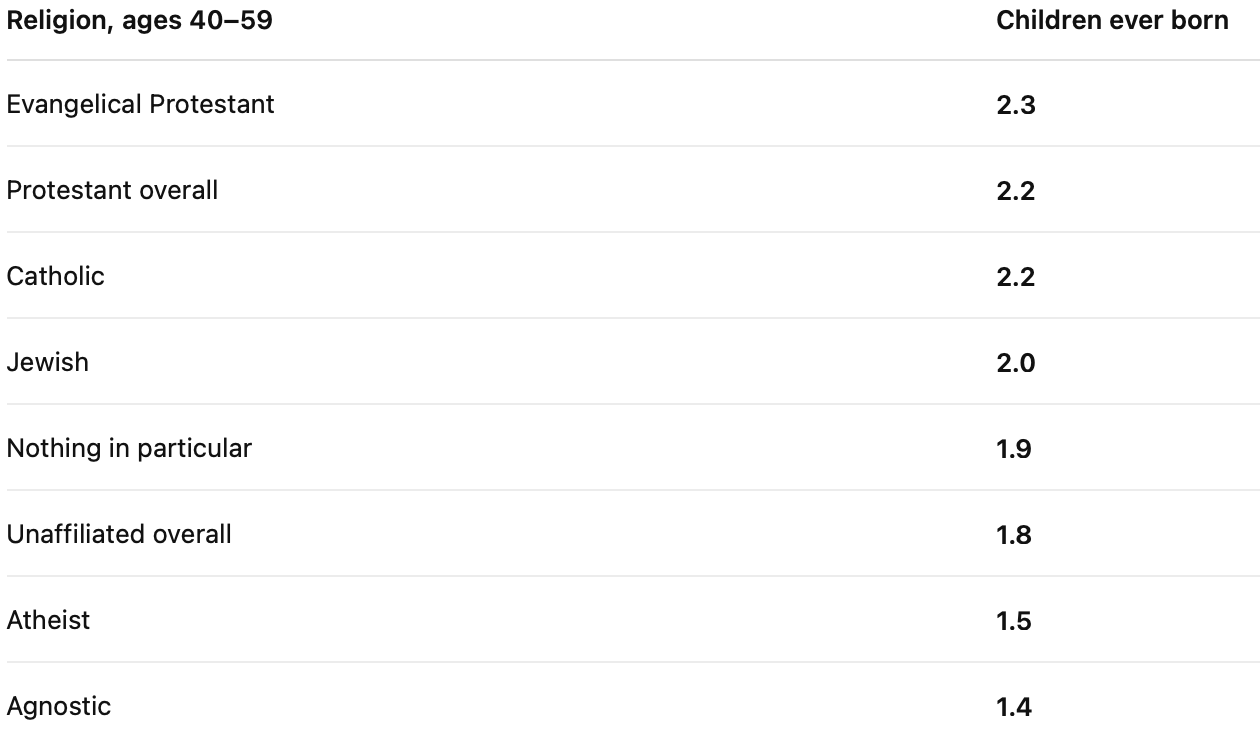
The 1.4-1.5 completed fertility of atheists and agnostics is already extinction-level. The current picture is likely worse, as these are women who are 50 years old on average, who came of age in the 90s. I asked Dr. Claude to extrapolate this into the future with reasonable assumptions, for the white population to avoid potential ethnic confounders (though the directional trends hold for every group):
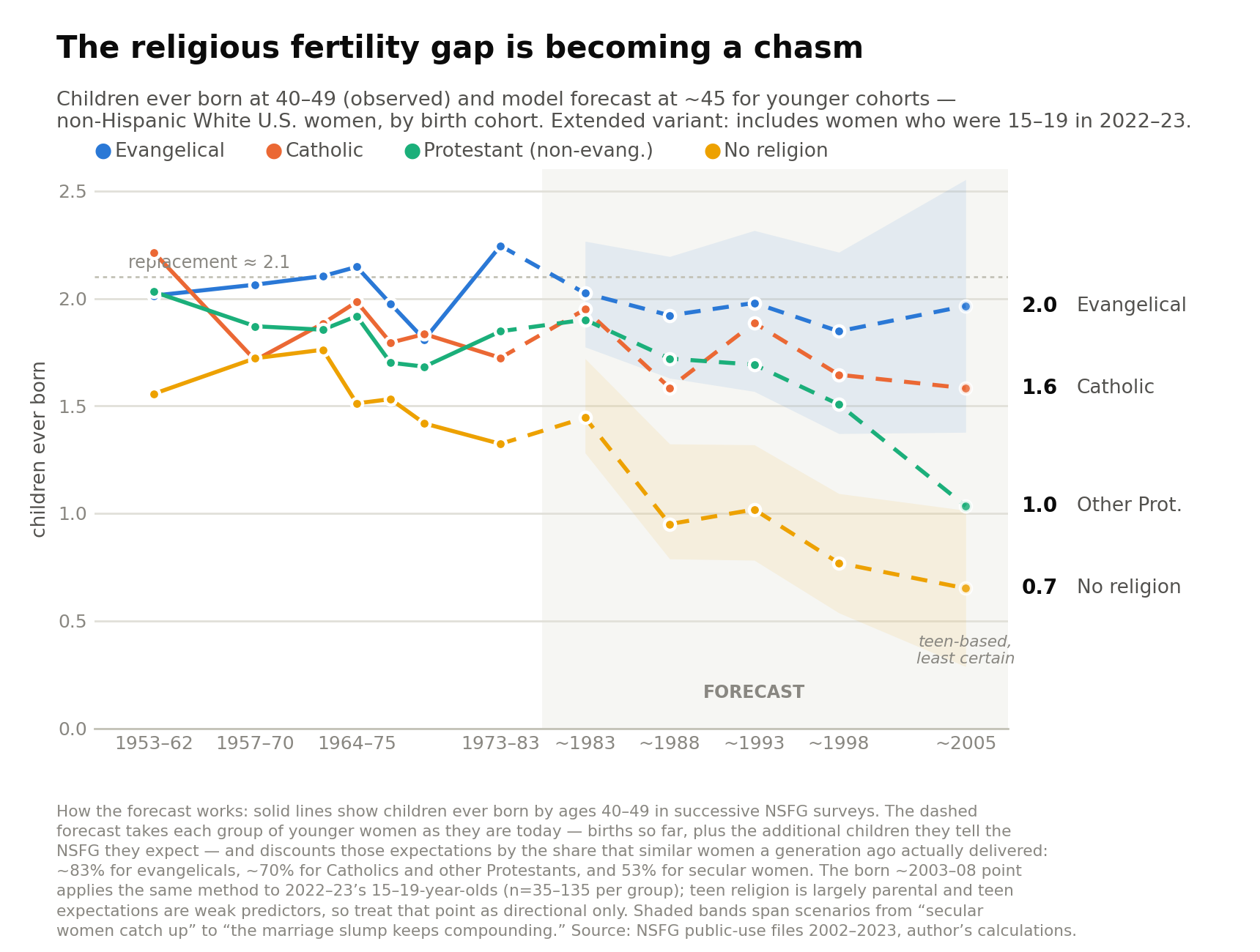
Notice the youngest white evangelicals, those born in 2005, are predicted to climb back to near-replacement. This also, no surprise, runs along the political spectrum. And while we don’t have enough data to project future fertility, we do know that more conservatism equals more babies:
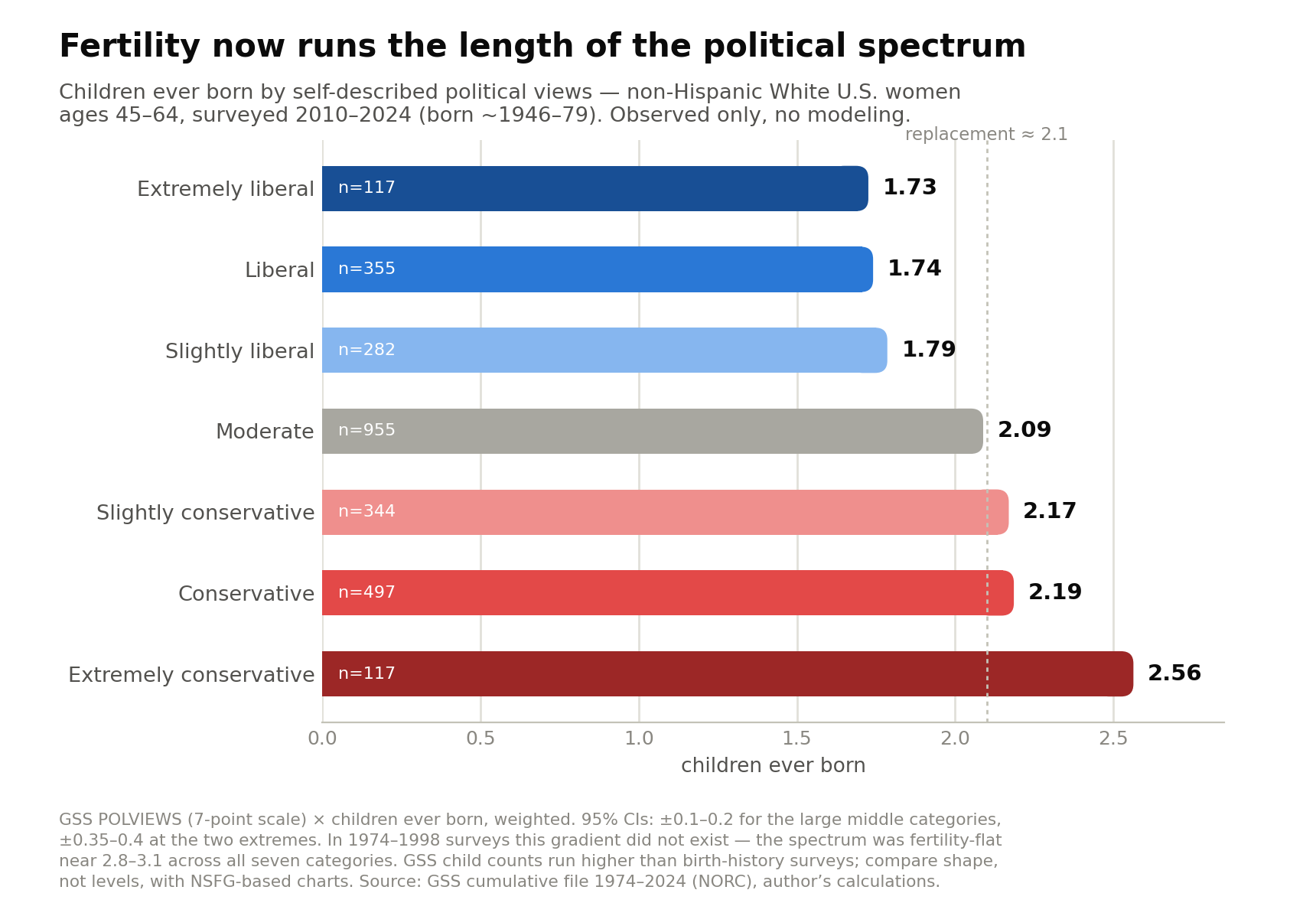
These numbers feed into deterministic equations with exponential effects. The chart below shows the effect over a century for a given starting population:
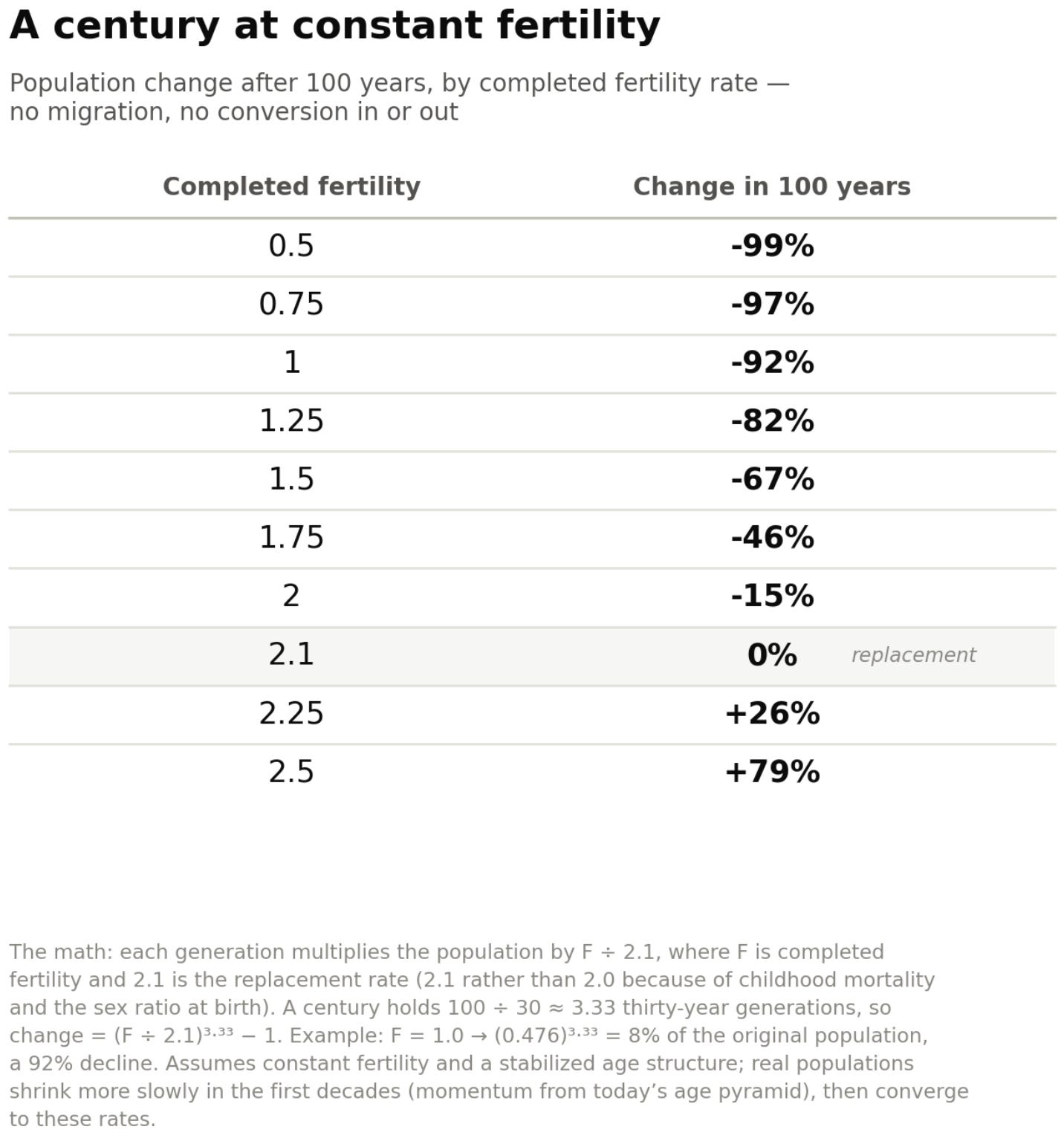
The future is extremely religious and extremely conservative. When societies founded on the delusions of Locke degenerate into the sterility of Foucault, nature and nature’s God call upon the mechanisms of His sterner prophets, Calvin and Darwin, to elect and select their replacements. I’ll speculate on what that means in Part Two.
And this is probably still reduced for all of us, even those of us who had formative years before the Internet but after mass media, and we tend to forget that overstimulation dampens rather than amplifies response and desire. In Lonesome Dove, sexual stimulation on the Texas frontier was so rare that a single, beautiful blonde woman in town, her face seen in a brief moment through a window, was enough to send several male characters into multi-month obsessions and daydreams about the possibility of being with her.
Some may protest that it seems that many men do not want these things either. True enough, but it is almost universal among sexually reproducing species that females set the terms of choosing males, a lesson demonstrated over and over again in nature documentaries, from elk to birds of paradise. As Jordan Peterson put it, “It is Nature as Woman who says, ‘Well, bucko, you’re good enough for a friend, but my experience of you so far has not indicated the suitability of your genetic material for continued propagation.’” When women demanded marriage as the price of sex, men fell in line to provide commitment and resources.
Men have other gifts, of course, like extreme focus and analytical abilities, but these are not subject to equivalent economic demand, because services, where women are most comparatively advantaged, are hard to scale. Aging Boomers will need way more nurses than IT guys who keep the hospital network running.
I saw a recent analysis that, rather unbelievably, claimed that all organized violence by men in all of human history totals about one billion deaths, while female violence via abortion in the modern era totals three billion. The math checks out.
There’s an odd colonialism at work here as well. A recent X post reported that “We spent over $100 million testing ads and landing pages. Attractive women beat everything. We tested hundreds of images and the winner was always... a hot woman. Our perennial champion was Scandinavian.” This phenotype is likely a consequence of historically rare sexual selection operating on women. Some have speculated on the cruelty of “European beauty standards” and their effects, and I agree not because beauty is arbitrary but because it is not. One can only imagine how some equatorial villager would be affected when exposed, through a smartphone, to nonstop images of this ethereal, neotenous beauty, only achievable by millennia of pre-Christian monogamy and the heightened sexual dimorphism that can develop when cold winters demand almost exclusive male provision of calories from hunting. While all are impacted by mass publication of outlier female beauty, those who could plausibly be or marry her first cousin will feel its impacts less keenly. This may significantly account for resentment toward European peoples among immigrants. Beauty is arresting because its recognition is involuntary and undebatable.
This feels like liberal projection, because left-wing ideological androgyny represses natural sexual polarity when it comes to normal things like division of labor in a family, which causes its return at greater pressure and destructive intensity. A recent hit chick-lit novel, Yesteryear, depicts a Ballerina Farm-inspired influencer transported to 1855 as a comeuppance for her advocacy of a modern homesteading, tradwife lifestyle. Yet the left-wing author depicts the protagonist being more attracted to the stern 1855 version of her husband, who hits and rapes her, and in describing her experience, “for the first time in my life, I am being properly satisfied by a man.” Fifty Shades was, according to a Goodreads analysis, most popular among wealthy women in the liberal Northeast, and no doubt similar regional biases apply to The Handmaid’s Tale, which, as part of its dystopia, features specially chosen young women forcibly impregnated by the elite of a future theocracy. Maybe it’s just me, but wearing an apron and baking sourdough seems healthier than thinly-veiled fantasies about domestic abuse, forced childbearing, and rape.
The fundamentalists who fear sex seem to be burning themselves out over time. Their predominance in rural areas means their children are more, not less, exposed to destructive cultural patterns — see, for example, the dinergoth phenomenon, or homeschoolers stuck in the 90s who don’t realize that unsupervised time online is way worse than unsupervised time with the opposite sex — than the more intelligent, intentional conservatives in the suburbs. The one exception here is the extreme fundamentalists who cut themselves off from modernity entirely, the Amish, for example, who at 6.1 children per woman currently account for about 1% of live white births in the US and, if trends continue, will constitute 35-50% of white births in a century.
As much as I dislike the idea of travel sports for their time consumption (and seeming likelihood to limit family size), the high-energy parents in that world are following good instincts, as a way to get their kids off screens and away from depressed, dysfunctional peers. You’d much rather your son work on his pitching, even if delusional about his D1 prospects, than spend all day on Reddit or playing video games. Even curmudgeonly traditionalists see the value.
Humanity is a plague, a vermin like knotweed. The most humane solution would be to euthanise the entire species.
So the only way this utter tripe is if can ever succeed on getting people to believe it if they have been brainwashed from birth. It’s like watching the triffids take over.